“I don’t deserve to relax” is a feeling that runs on my default-mode, where I am very used to feeling like I’m being lazy, even after a very busy and productive work day.
It’s not imposter-syndrome at all, it’s more of an inbuilt calculation of ‘work done’ vs. life quality. Where if my life quality feels too high for my work done, more work must be done to justify it.
As I’ve grown up and got into my mid-30s now, my life quality has improved a lot, I drive a really nice car and I’m lucky enough to live in a beautiful house in a beautiful area with my husband.
But what this has done to the ‘work-done’ side of the equation has only made me feel more uncomfortable and lazy. I feel everything I have is on some level unearned and work must be done to atone or account for this. That what I put in must in some way be equal to what I get out.
I suppose it’s the direct opposite of the energy projected by old money. I’ve found that the people I know who come from the wealthiest families are enviably usually the calmest and most present people. They seem to take life in their stride and never hurry, able to calmly decide when to buy, when to sell, and when to take action, with a soft buffer of tranquility all around them.
It could be called ‘entitlement’, the feeling that they are entitled to the world. This thing I feel is whatever the opposite of entitlement is. Unentitlement?
I think the flaw in my mental calculation is the assumption that I am directly responsible for my quality of life. In reality the vast majority of my successes are enabled first by broader economy, geography and time.
The most hardworking people in history are unlikely to be the ones most rewarded for it. How lucky am I to not be born in India, to not have to compete will a billion other people my age for a good job.
Similarly this feeling is found in the attitude of our parents’ generation, most of them having their wealth accrued not from work at all but from buying property at the right time. The work meant ‘how much of a mortgage they could get’ but the real wealth came from the property’s value increasing at an often faster rate than they could earn the same amount of money from work.
The American attitude embraces this flawed way of thinking the most, their mainstream attitudes towards homelessness and prisoners revealing it most clearly. That your successes are yours to own, and your failures are yours to bear.
I really don’t think this is true, it’s only very very partially true, but we believe it to be totally true because that enables us to be the best agents in the world. We need to believe in this illusion of control because, oddly, it produces the best outcomes.
We are floating in an ocean, being pushed around by the waves and the currents. We can swim as hard as we can in one direction or another, but we don’t really get to choose where we end up.
If you believe that all your successes are a direct result of your work this can also make me (and you) very arrogant, even perhaps at the same time as making me anxious, lazy and suspicious.
The Pope talked about this last month when discussing AI’s effect on the modern world, and the attitude adopted by Tech titans like Thiel or Musk:
Those who command powerful technological and economic resources, along with substantial human capital for intervention, possess significant capabilities for influencing cultural change. Ultimately, they can influence a significant number of people concerning the truth about humanity, the world, the meaning of existence, the family and even God. This is pure power detached from truth, which subtly or overtly imposes what it wishes others to accept as true. At its root lies a deeper and often unrecognized “sickness”: the fact that “modern man is wrongly convinced that he is the sole author of himself, his life and society. This is a presumption that follows from being selfishly closed in upon himself.”
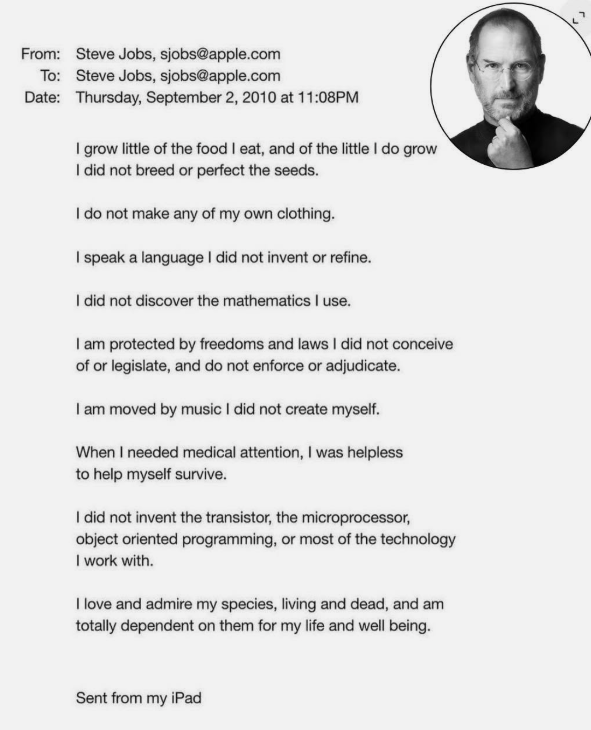
So I leave you with this, from my favourite tech titan Steve Jobs, who seems to have come to this realisation on his own, in this email to himself in the final year of his life:
Leave a Reply